Friday, January 18, 2008

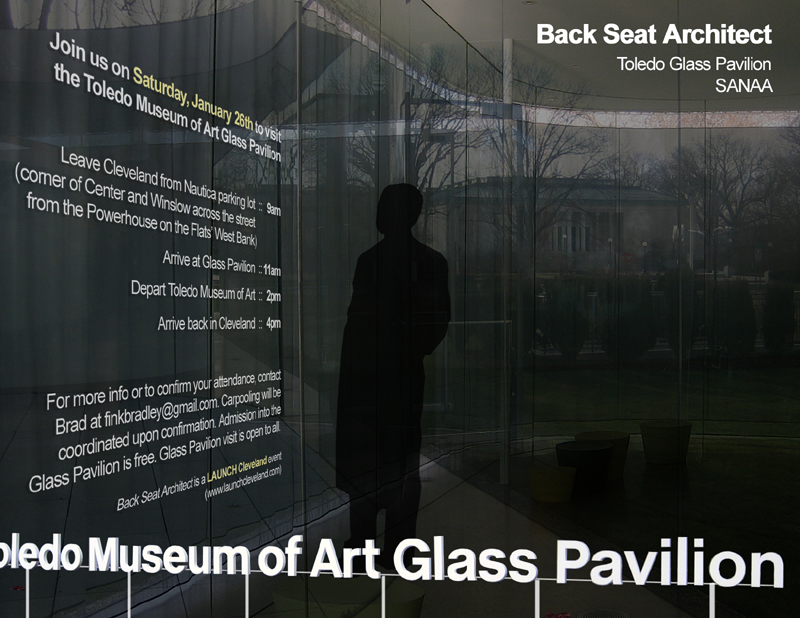
LAUNCH Roadtrip - Toledo Art Museum Glass Pavilion

Back Seat Architect: Toledo Glass Pavilion
Saturday, January 26th, 2008

In the spirit of seeing what the world has to offer (at least our conveniently located corner) and in lieu of the last roadtrip up to the Henry Ford Museum and Cranbrook some members of the local LAUNCH community (who's new website I am attempting to work on in all my spare time) are organizing another roadtrip to sunny Toledo. Home of the Mud Hens, Klinger, Pilkington Glass and the first non-smoking music venue I ever went to.

This funtime excursion will be to explore the Toledo Glass Pavilion which was designed by SANAA ltd. of which Kazuyo Sejima will be lecturing at Carnegie Mellon on Jan. 22nd.

I suggest if you have the time, would like to talk design with some local folks or just want an excuse to visit the Delmenhorst of the Midwest I would suggest you see Bradley of ClevelandDesignCity who is organizing this event about sharing a ride (save the planet and all that).

Wednesday, January 16, 2008

White House Redux Competition

What if you were wanting to design what the White House would look like today? Well, it seems you have the chance.

Introducing the White House Redux ideas competition being held by Storefront for Art and Architecture

JURY

Stefano Boeri (Editor-in-chief, Abitare magazine, Milan)
Beatriz Colomina (Director of the Program in Media and Modernity, Princeton University)
Liz Diller (Diller Scofidio + Renfro, New York)
John Maeda (President Elect, Rhode Island School of Design RISD)
Geoff Manaugh (BLDGblog and Dwell magazine, San Francisco)
Mark Wigley (Dean of the Graduate School of Architecture, Columbia University)
Laetitia Wolff (Editorial director, Surface magazine, New York)


PRIZES

The best competition entries from around the world will be exhibited in the Storefront Gallery (New York) in July 2008, and in a special page on the gallery's website. They will also be published in Surface magazine. The authors of the three best projects, as chosen by the jury, will be flown to New York and given three day's free accommodation in The White House Hotel on the Bowery.

First Prize $5,000
Second Prize $3,000
Third Prize $1,500


TIMELINE

January 15, 2008 Competition launched
March 1, 2008 Online submissions accepted
April 20, 2008 Registration and submissions deadline
May 2008 Jury selects winners
May 2008 Winners announced
July 2008 Exhibition and prizegiving at Storefront for Art and Architecture, NYC

Tuesday, January 15, 2008

Breuer Tower...what can I say. We were smiled upon. Or at least we got a wink and a nod.

There really isn't all that much that I can add to the seemingly incessant coverage of the former Ameritrust Building being being purchased by K&D for $35,005,000.00 today (is the new sales tax part of that?).
K&D is a development group based out of Willoughby, Ohio who does quite a bit of residential development including the, at times, regrettable Stonebridge Condos.

However, one cannot overlook K&D's optimistic outlook for the city. I for one am entirely in favor of the former Marcel Breuer masterpiece being converted into a residential tower (in part) and would actually investigate a cost analysis upon whether it would be at all beneficial to call the tower a domicile. It would be closer to work cutting my commute to mere minutes, I wouldn't have to ever drive into the city at rush hour (unless coming home from someplace else), I could threaten people with my inferred tough demeanor gained by actually living downtown and I could research and document all the amazing places downtown that I ignore on my journey to and from home to work. Heck,I may even purchase enough junk by my own person to necessitate the increase in county jobs by at least one person.

Regardless of how much the building is worth, how much was spent on it and the effort it took us to get here (thanks again to Susan Miller and crew) I would like sigh a brief sigh of relief that I won't have to witness much more ham handed demolition done in the name of some special person who gives all bearded people a negative persona. I am sure his family is very nice, and although I don't like the tie in the picture on his website I am sure he has plenty of nice ones at home that he saves for special occasions.

It has been a big day. I am going to bed.

Check out the ClevelandDesignCity for more such amazing and well crafted/spell checked articles.

Also, what will come of all this? Oh man, are we in for a DOOZY!

Monday, January 14, 2008

Roadtrip - Fuller/ Noguchi and Eero Saarinen


This past Sunday a few of the Cleveland LAUNCH members decided to head up to Detroit to check out the Buckminster Fuller/ Isamu Noguchi exhibit at the Henry Ford Museum and the Eero Saarinen exhibit at Cranbrook Art Museum.

As a special guest (having worked with Eero and student of Fuller, as well as being a Cleveland architectural institution himself) Peter van Dijk was able to join us.

With Detroit being only 3 hours from Cleveland the LAUNCH team decided to take its first impromptu roadtrip and check out the 'local' exhibits. The Buckminster Fuller/Isamu Noguchi exhibit was first on our list. Included was an actual Dymaxion House as well as some sculpture, a Dymaxion Car, some tensigrity models and a few films.

Heading North for half an hour brought us to Boomfield Hills, home of Eero Saarinen's old office and Cranbrook CEC. Unfortunately our Cranbrook alum was unable to make this particular trip (for he no doubt would have steered us to some fine establishments for sustenance, instead we had flaming table side cheeseburgers). The campus of Cranbrook is rather amazing, sprinkled with fine buildings, sculptures and parks. I was lucky enough to visit once during Graduate school at Kent State and was immediately jealous that I did not take that option.

Regardless the Saarinen exhibit was huge. Various models, construction drawings, full scale mock-ups, photos and films overwhelmed the senses. I was trapped admiring the details and hand drawn construction documents for the TWA terminal for quite some time. Once in a while Pete would pull one of us over to a particular exhibit to tell us a story about someone who worked on it or working on the project himself. There were cartoons and photos of the staff on a far wall which were typically being admired by those of us in the profession. Luck also aligned for one of Pete's old coworkers from Saarinen's office to happen to be at the exhibit at the same time as us and we were lucky enough to be introduced.

In fact the whole trip was amazing, in fact I am more than willing to go back. There is something about seeing an exhibition of successful and impressive work that really does invigorate and excite me. I am constantly surprised at how simple it is to really grab some fellows and head out for a quick daytrip to admire some well done work.

I am quite sure that the LAUNCH group will be organizing more trips to come.
*cough cough*

resources:
"Reconsidering Eero" Metropolis Magazine
The Buckminster Fuller exhibit ends the 15th of January
The Saarinen Cranbrook exhibit ends the 30th of March

Thursday, January 10, 2008

Great Design Can Change the World...

Rule number one according to Sir Michael Bichard the current director of the UK's Design Council.

The Design Council is a government organization that strives to "...helping business become more successful, public services more efficient and designers more effective." On their site they have a nice collection of case studies regarding challenging the status quo for good design.

Bichard has also helped come up with these "Five Rules of Design"

1. Great design can change the world and move people
2. If you think good design is expensive you should look at the real cost of bad design
3. Design, creativity and innovation are essential if we are to meet the global challenges of sustainable development
4. Design is not just about products and communications, it's also increasingly in the services we receive or buy
5. To consume design is a creative act - and everyone can be creative!

While I may not agree entirely with all the rules (perhaps withholding any consumption is an act of design by inaction) I find it interesting that a governmental body would create a "national strategic body for design" and am curious to delve into how that sort of agency would work in the United States. It isn't that they police design, calling out what is considered poor ideas, but instead utilize funding and agency research to further design base businesses which almost sounds akin to National Endowment of the Arts but is more business related.

Instead of being used as a reference guide or a council of decision makers per say, the Design Council instead acts as an information aggregator and business advisor which attempts to help businesses boost competitiveness through the use of good design strategies.

I thought this went pretty well with the current posts, especially Roger K. Lewis's article on design review boards

Fun Resources:
Downloaded Design Council Resources

Ganked from Core 77

Core 77 - Greener Gadgets Design Competition

Greener Gadgets Design Competition

Can we save the world through good design? A lot of people think so. I know I would like to think so.

Core 77 and the Greener Gadgets Conference have announced a design innovation competition "to address the issues of energy, carbon footprint, health and toxicity, new materials, product lifecycle and social development."

Submissions can be accepted until January 27th, 2008 at 11.59 pm EST
Finalists will be notified January 29th, 2008

Finalists will be shown at the February 1st, 2008 Greener Gadgets Conference in New York City.

Granted the competition seems to be laid on quickly but I think there is plenty of time to finesse out some of those ideas I bet most of you have kicking around your noggins. Prizes are US$2500 for first and US$1000 for both of the runners up.

Intent:
Design Brief
We're inviting designers to explore the concept of "Greener Gadgets." Designs should seek to minimize the environmental impact of consumer electronic devices at any stage in the product lifecycle. Areas of sustainability to consider include:

1. Energy
2. Materials / Lifecycle / Recycling
3. Social & educational development

Participants are encouraged to consider their designs as part of the entire product ecosystem, and should think as holistically as possible. Designers may choose to focus their entries on a particular area of human enterprise (learning, playing, communicating, etc.), or a particular context (work, home, school, etc.), a particular material, or a specific device. Entries may also seek to create new paradigms for products and services

Ultimately, we are looking for "great gadgets" of the greener kind.

Wednesday, January 09, 2008

A Public Arbiter of Good Design - Design Review Boards

What is the basis for the arbitrary regulation of design?

I mean seemingly arbitrary regulation. I suppose that statement stems from the provision that unless design aesthetics reflect a thought process inherent within a specific project than the application of "design" as a commodity, is relatively arbitrary. Which of course must be justified and judged by a relatively arbitrary collection of judges (the design review board) that may or may not render their decision based upon a understanding of intent any more than personal preference.

Roger K. Lewis of the Washingtonpost argues that while land use and zoning regulations have a practical and legal backing most design reviews are hard to quantify. Personal taste and opinion may unduly influence critique in such a manner as to be detrimental to the community that would be affected by a proposed project. Once the possibility of political and personal intents are added to the equation the entire design review process becomes even more dubious.

There are the classic murmurs how those with an intimate familiarity with design should take the time and effort to populate their community's design review boards, however many people find these positions an easy way to feel important/connected and to profess personal ideologies upon a community that may or may not follow the same beliefs. One colleague stated, when I had considered joining my local design review committee (which I ended up not submitting a CV for), was that I "must not have enough work to keep me busy" with the assertion that those on the review boards are not talented enough to find enough work so instead they critique (similar to the adage that those that cannot do, teach) which is such a seemingly bitter statement that it doesn't even deserve a rebuttal.

Instead I agree with Lewis, that design review boards would do well to create a set of community standards and ideals, to maintain a high level of professionalism and intellect on the board coupled with a passion for the community that would be indicative of a strong belief system and personal reverence for the neighborhood that are, in effect, being protected. Only through creating a raised level of expectations for design can communities elevate the inferred value that is placed upon aesthetics and the rigor of problem solving. Whether the boards should be elected positions or even how this level of decorum would be maintained is beyond me. I don't profess to have all the answers (all the time) but I do suggest that systems in place and effect are continuously questioned in order to prove that they are working to our benefit and that they are still effective.

It isn't so much that I feel design review boards are a flawed system, or even that my personal interaction with them has been awful. Instead I found the article interesting in the assertion of how the system could be improved to the advantage of the design community and the 'city' as a whole.

Tuesday, January 08, 2008

Harnessing the awesome heat power of...people

We have all been in places where the crush of human bodies has resulted in uncomfortable temperatures. In some places this unavoidable occurrence can only be countered with a large mechanical cooling system.

Until someone discovers a way to utilize this energy.

The Stockholm Central Station is configuring a mechanical system that instead of simply removing the excess heat from station they intend to capture this energy to heat an adjacent office building.

The proposed system will utilize a closed loop heat transfer system that will distribute water warmed up by people in the Central Station to a new office building that will house a small hotel and a few shops.

The additional cost of the pipes and pumps is not, by itself, cheap. However projections of system use offer a 20% reduction in energy use from a standard heating system that when added to overall cost of the building makes the added cost seem "not that much" according to Karl Sundholm of Jerhuset, a property administration company run by Swedish government.

If proved viable restructuring building systems to take advantage of the occupant usage instead of merely treating building program as a 'problem to be solved' may become an effective way to structure design solutions for occupied projects. Besides generating power (don't forget to check out this link on crowd farming) I wonder what other potential solutions are in the proposal phase...

Monday, January 07, 2008

Global Warming as Risk Management - "How It All Ends"

One doesn't have to win a Nobel prize to have a valid view on issues of international import. By the same token any nut job with a webcam can make a video (and every kook with an internet connection can start a blog), however when issues are presented in an intelligent manner that is based upon logic more than simple emotion and when the issue is arguably one of the most important issues of our lifetime (possibly for the species), I would find it hard to argue that you couldn't spare 10 minutes of your time.

How It All Ends video (youtube for you poor saps who have it blocked at work)

The first video is simply a basis for the argument of whether or not humans should take action to fight global warming. The next of the series deals with what one can do, the risk management aspects of choices, etc.

While only a simplified exercise in demonstrable logic it does concisely emphasize the point that it would be better to do something and be wrong than do nothing and be screwed. What can I say? I am a sucker for whiteboard and a logic matrix.

First Tremont Art Walk/Hop of 2008

Maybe?

I checked the website but nothing is listed for 2008. I haven't been to Lucky's Cafe in over a month either so I haven't run across any of those card type things. Hot cards I think the kids call them.

Oh well. I suppose there isn't any harm in going and checking it out.

January 11th, 2008
Tremont Area of Cleveland Ohio

Saturday, January 05, 2008

Local Music Store T-shirt Design Competition

Here at the TOIstudio I fervently keep watch for interesting design competitions. Why? Because I get so bored so quickly and also because half the fun is seeing what other bored people come up with too.

So, in the grand spirit of the New Year (Happy New Year to YOU) I am proud to announce (or pass along the message that...) Music Saves is holding a t-shirt design competition.

The rules are simple:
2 colors max (0 colors min?)
front or front and back designs
you may specify shirt colors if need be
you must include the Music Saves logo and represent it in a complimentary fashion (Awww, no Calvin peeing on logo's?)

Submission is due MIDNIGHT (EST) JANUARY 31st
Submission:
Full size 300 dpi flattened TIFF in RGB mode
Template showing design position on t-shirt
Email submissions to team@musicsaves.com

Submissions will be posted online February 1st so that people may vote on them. Winners to be announced February 15th.

Winner will receive 2 t-shirts, $75 gift certificate and group hug!

Friday, January 04, 2008

The sweet smell of fuel independence...smells like fries

There is something to be said for those that instead of arguing about the practicality of certain ideas, decide to tinker with the mechanics until they get it to work and then use a functioning example of their argument. I would find it hard pressed to argue with Stephen Merrett of Oberlin, Ohio who, at the ripe old age of 24 has not only converted over 100 diesel vehicles to run on waste vegetable oil but who also owns and operates the Full Circle Fuel Station on Main Street in Oberlin. Full Circle is one of the few waste vegetable oil stations in the country although the number of stations that are selling biodiesel appear to be rising.

Fresh out of college Merrett attained various grants that allowed him to work with Ray Holan, another proponent of waste oil recycling and biodiesel conversions who has worked with local Cleveland businesses (such as the Great Lakes Brewing Company)to develop biodiesel vehicles for the company's use.

Typically one can get waste vegetable oil (WVO) from restaurants but would have to store and strain the oil before using it in a vehicle. Biodiesel fuel stations are able to supply the waste as a fuel at a reduced rate (compared to traditional petroleum fuels) because the restaurants give away the waste oil instead of having to pay to have someone remove it.

Typical automobile conversions can cost upwards of $1,500.

Resources:
Biodisel.org Retail Fueling Station locations, USA
Good Grease WVO site
Big Green Bus
Balanced Living Magazine article on GLBC and Ray Holan
Plain Dealer article

What color would Cleveland be? Emotional Cities

What if the city could physically represent the emotion of its inhabitants?

What color do you think we would be?

Could different areas have a different color?

An artist named Erik Krikortz has launched a website where one can, among other things, vote on how they are feeling that particular day. Accumulated votes are tabulated and then represented by being projected as a color wash upon a series of buildings in Stockholm.

Visitors may also post in a diary about how they are feeling however the entries are not visible to any other user. While currently only in Stockholm Krikortz plans for more installations in more cities, hopefully in public spaces, that can be run concurrently with scientific studies in order to corroborate the relationship between media/expression and mood.

The cynic in me figures the current governmental body would jump on this as a way to demonstrate the 'terror alert level' or some other relatively useless information (to the general public that is. Really, if the terror alert is 'high' what are you going to do about it besides be scared and eventually indifferent?) however the link between color theory and design has always intrigued me as a viable communication tool and I hope that these installations and studies move forward.

I would be intrigued to discover if specific cultures have a different emotional responses to the different colors of the color scale and if that would affect voting preferences, or how if the city is portrayed as 'happy' or 'depressed' through a major lighting installation the affect upon those that live/work in the area. Would they notice? Could this be used to test cognitive dissonance and self-perception theory on a large urban scale? Could we alter our own perception of where we lived based upon some pretty lights?

Stranger things have happened.

Thursday, January 03, 2008

Back of the Envelope Bush Library Design Contest

Not to insult Robert A. Stern (Yale School of Architectural Dean and proposed designer of President Bush's library) but the Chronicle of Higher Education is currently hosting a contest for Bush Library Design Proposals that are to be sketched on the back of a size-10 envelope as if you were just conversing with the President and quickly jotting down some ideas.

Design proposals cans be 'serious, humorous, adventurous, or all of the above' and the grand prize is a iPod Touch.

Rules.pdf