Photos and information can be found here on the Pritzker Architectural Prize Website
Monday, April 13, 2009
Pritzker Prize 2009 Laureate - Peter Zumthor
Friday, April 10, 2009
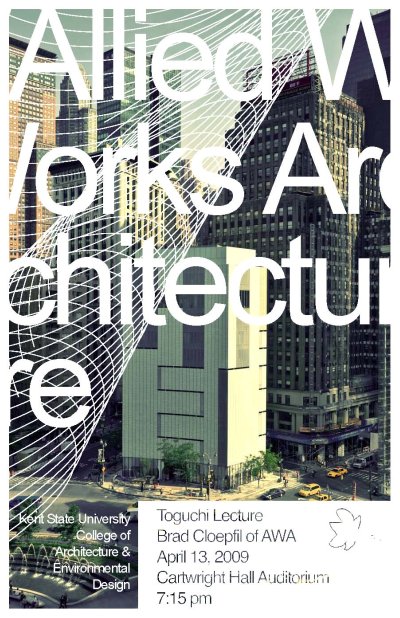
Kent State Architecture tries to sneak another lecture past us - Brad Cloepfil
Monday, April 13th, 2009
Brad Cloepfil of Allied Works Architecture
Cartwright Hall at THE Kent State (top secret events) University
7pm (although the poster says 7.15pm - I am thinking no one knows what the hell is going on there anymore)
Special thanks to Jacob at archinect for mentioning this, even though when I was down for the last lecture, last week, and mentioned to staff that getting the word out would be awesome for those of us interested in design, no one mentioned the upcoming lecture at all. Not a damn peep.
Knowing is half the battle.
Cleveland Sacred Architecture Tour I
2027 W. 65th St.
10am
St. Stephen
1930 W. 54th St.
11.30am
AIA Cleveland, the Institute of Classical Architecture and Classical America have begun compiling tours of recently closed Catholic churches in Cleveland and the surrounding area in order to celebrate much of the architecture before it is lost forever. This first tour is to mark the beginning of a series in which groups of visitors will be led (by Tim Barrett) will be exposed to and have time to capture some of the grand spaces and details. Participants of the tours are encouraged to bring cameras (video and still), sketchbooks, etc. AIA Cleveland hopes to stage an exhibition of the recordings.
In light of the pending closure of so many of the region's Roman
Catholic churches, tours of several of the most significant ones have
been scheduled. On April 18, the first tour begins at 10 am, at St.
Colman Church, the second tour begins at 11:30 am at St. Stephen Church.
Future church tours will be announced as they are scheduled. The tours
are free of charge and Continuing Education Credits (1 HSW unit per
church) are available.
flier
Thursday, April 09, 2009
any press isn't always good press - cia addition makes list of dubious honors
I had this article pointed out to me a couple of days ago. I was trying to find the article online but couldn't so I apologize for the crummy scan (which you can click to enlarge to readable size).
Not to be outed about it but I actually liked MVRDV's "bump and kiss" proposal and found it to be a much more interesting addition to a cultural institution than the proposed Burt Hill addition which is rather disappointing (especially when compared to OSU's newer Knowlton Hall design studio's building which embodies what a studio workspace could be if it were designed for working or designing in).
Article thanks to ID Magazine who I hope won't ask me to pull the scanned page right away so that Cleveland can enjoy being architecturally infamous, again.
Tuesday, April 07, 2009
Tremont Art Walk - April 2009
Monday, April 06, 2009
Innerbelt Plan Public Meeting
Tuesday April 21, 2009
Annunciation Greek Orthodox Church
2187 West 14th Street, Cleveland, OH 44113
4-8pm
In accordance with the National Environmental Policy Act (NEPA), the purpose of this hearing is to provide an opportunity for review and comment on the project’s Draft Environmental Impact Statement and for citizens to provide feedback through written, verbal or recorded verbal comments. In addition, in accordance with the National Historic Preservation Act, public comments are requested on projected impacts to historic properties.
Comments received (by mail, email, or fax) by 5 p.m. Thursday, May 21, 2009 will be considered in the Final Environmental Impact Statement. Comments may be submitted to:
Ohio Department of Transportation, District 12
Attention: Craig Hebebrand
5500 Transportation Boulevard Garfield Heights, OH 44125
Fax: 216.584.3508
On the Web: www.Innerbelt.org
Just imagine how important this project is to businesses in and around Cleveland. Then imagine how many commuters it affects as well as visitors coming from the airport. Now maybe it becomes apparent how vital the innerbelt bridge is to not only the fabric of the city but also our image. I understand the need to rush this project in order to capitalize on federal money but that should not supersede the base requirement of a project being done well.
Sunday, April 05, 2009
groundbreaking vs groundbreaking
Above are two images from two almost adjacent projects. Circle 118, which exists on the corner of Euclid and East 118th and 27 Coltman which are being constructed on Coltman and East 119th near Euclid Ave. The Euclid Avenue and the Red Line are all that separate the two sites.
It was interesting to note that Circle 118 broke physical ground in mid March and has already begun excavating (or at least started pushing giant piles of dirt around) and seemed to completely bypass the public groundbreaking ceremony. Meanwhile the Coltman project had its groundbreaking ceremony March 27th which consisted of the standard blessing, photo ops and party (held at the Sculpture Center) which drew a pretty large crowd (estimated at around 300). However the Coltman project still doesn't have any equipment on the site.
Word on the street (from a single unverified source for whatever that is worth) is that both projects have units moving and should both be realized, which would be quite an interesting achievement in this market.
So what is a groundbreaking? Is it the actual beginning of construction? A milestone that indicates that funds have been allocated and are being utilized in the building of the project or a large ceremony which attracts a large crowd and fanfare but does not indicate any actual construction? I ask because I find both happening in the absence of the other rather interesting and perhaps a little telling about the life of building projects in Cleveland.
I am leaning towards the physical moving of earth in preparation of building to indicate a true groundbreaking and even though the Coltman project threw one hell of a party, I fear they have a bit of catchup.
Friday, April 03, 2009
Craig Scott lecture reaction - KSU spring 2009 lecture series
The lecture happily consisted of much more than a simple traipse through a project portfolio as Scott illustrated not only a series of projects ranging from art installations and large scale masterplan proposals, but also the rigor and trials that exemplified a well thought out and practiced approach.
An aspect that permeated the projects shown was an almost childlike sense of awe at exploiting the constraints of materials. Utilizing digital media to create electronic models, ideas were quickly studied and metrics of evaluation were formed. However, what makes iwamotoscott architects so very interesting is the then deliberate exercise in physically studying the material constraints and exploring the visual and tactile relationship of construction.
From the Voissuir Cloud installation at sci arc (which employed a rigorous structural study and painstaking craft of construction to execute) to the REEF ps1 proposal (which required a half scale model to verify that the inferred material properties would react in a predictable fashion) the love of crafting shines through. Somewhere through their history, Lisa Iwamoto and Craig Scott's desire to discover the pure truths of material exploration has ingrained itself richly within the partner's ideals and it is a testament to the tenacity of the firm that these explorations are so finely executed.
I suggest that greater attention is to be paid to the impetus behind these and other proposed projects including the Ordos 100 villa, Hydro-Net (designed for the History Channel's City of the Future, and the proposal for Battery Park South (whose images should be released soon) for each project, as diverse in construction or scope as possible, rely on a sense of desire to empirically explain the truth of and through materiality and then fashion the proper technique to celebrate it.
Monday, March 30, 2009
Craig Scott Lecture - Kent State University
at:
Saturday, March 21, 2009
scale: amenity and destination
To be fair the main purpose of the aforementioned conversation was whether a destination could result in direct community amenity, in this case "Would the Cleveland Med Mart truly bring some life to downtown Cleveland?" The lens through which the incident was being initially studied was as a Clevelander who would like an excuse to go downtown more but find it a bit boring. What would the Med Mart do for people like me?
This acknowledgment was immediately a mistake. I am not part of the community that the Med Mart would serve, there is a larger National/International Medical community to which is being targeted, I belong to a second localized group, one that is tied via geographic location which according to my previous statement of "finding downtown Cleveland boring" can easily be overridden. Here usage beats simple proximity. Would the Medical community be drawn to the Med Mart? If it offers ease, convenience and purpose then one could assume that the community would definitely visit. Is there a geographic based penalty (distance = less opportunity to visit)? Possibly but again, geospatial location can be easily overridden (through the marvels of planes, trains and automobiles).
What then about local community amenity such as grocery stores, libraries, schools, etc. Some offer function that cannot overcome geographic location (schools typically serve a specific community), some destinations must serve those with limited transportation options (libraries, grocery stores) some overcome geographic limitations by constructing their own transportation system (hosptial/healthcare). Here the scale of the community being served is lessened as there are multiple destination/amenities created to serve multiple communities. There are more than one library, grocery store, school, hospital, each created to serve within a certain geographic location. Here the argument that the community is smaller and possibly more distinct allows this scale to be seen as the distinction between amenity and destination. However if the community (say the International Medical Community*) is highly mobile and there are less fewer amenity/destinations then the label may change depending on if your metric for scale is based upon local community or the more specific International Medical Community.
So what of the all important automobile? This creation really threw a monkey wrench into the scale argument of community amenity and destination. Initially the sense of scale shrinks to include only those that are located within the automobile. As most communities do not strictly delineate with signage at the borders the automobile creates this highly mobile but highly contained sense of space that defeats the geographic limitation (average daily commute in the US is around 48 minutes) exposing the auto traveler to multiple communities in one journey albeit usually only to limited areas (those with the quickest passage through). Previously to the advent of the auto (and for most citizens until they turn at least 16) the local community is defined by a radius that is easily walked (or ridden by bicycle) which allows not only the option of a more meandering path (and greater intimacy with the community) but also sets specific delineations of where the acceptable "edges" of the community are (based upon physical exertion, spatial familiarity and geographic properties). Again, another scale is developed that must be supplemented by an eagerness to travel once auto access is granted.
Public transportation is an anomaly that stitches the difference between pedestrian level travel and auto travel. The community is expanded to include whomever is on the bus/train and the continuous stops and less engaged operation (for the passengers) allow more time to identify with fabric along the route. Still travel is limited to a predetermined path, however it becomes more than simply a destination to destination journey as there is the introduction of a larger population (passengers) and more frequency of interactive changes (stations).
Regional access allows the metric by what we consider an amenity to shift based upon our mobility however the way that we also define ourselves alters what the basis of our communities are. Simply put, if we were to only define ourselves as Clevelanders, then our community would be simply Cleveland. If were to expand our self definition to include cultural attributes such as hobbies, occupation, or interests then our sense of community would expand and by extension our definition of amenity. The argument that is most often heard is based upon an assumption of which community is being served and in which manner, regardless of whether the "target demographic" is stated. Air travel and the ease in which some may attain access to other parts of the world have created a lens that can encompass a larger community, stretching from the city region to encompass entire nations. There is a direct connection between our mobility and geographic limitation and what can be logically considered a "community amenity" if the community is being defined by only geographic terms. This makes an important distinction between the attempts to capitalize on existing cultural/community amenities in order to create greater exposure to a larger "culturally based" community.
Again, to make a proper argument a sense of scale must be defined in order to validate the assumptions made when considering what a community truly is. Today's modern society is highly mobile and exploratory and has found easy ways to breach the geographic limitations that have been placed upon it in earlier decades. This isn't to say that local geographic communities would succeed if they abandoned all local amenities, but it is to suggest that cultural destinations are rapidly becoming cultural amenities and population migration will shift in response to such.
*to be fair I do not know if there is an International Medical Community but it sounds scary to me.
Thursday, March 12, 2009
Tremont Art Walk - March 2009
Tremont Art Walk
Friday, March 13, 2009
Tremont Neighborhood, Cleveland, Ohio
6 - 10pm
Sunday, March 08, 2009
salvation
Personally early Sunday strolls to fetch the paper (whose ever shrinking comment can be criticism for another day) allows a rather selfish vice of mine; to walk past the few places of worship along the way and catch the sounds of praise, song and homily, beautiful and heart warming (even when muffled through the heavy doors). Immediately my mind's eye remembers the sun streaming through the great stained glass windows of my youth, the droning of the priest (I was an impatient lad) and the sense of anticipation for the traditional family breakfast at my grandparent's. The Church followed the traditional Catholic style with proper nave and side aisles, a wide yet shallow apse and rather small transepts which hinted at the proper form. Tall and spacious inside I was lucky enough to have my first job there, helping my father, at the age of 13. There was a community pride that was evident those days in how the congregation knew each others family and history. Handshakes and pleasantries were exchanged and actually meant, even during the holidays when the congregation would grow to standing room only it was not uncommon to leave the church an hour or more after the sermon had ended. I was lucky enough to grow up around a such a place that actually felt as if it were God's home, if not for the architecture but for what it meant to the parishioners. I imagine that each holy place is like that to those that take the time to get to know it.
Now that some churches are being closed, offering that the community has no suggestions or proper reuses, what are to become of these structures? There are so very few buildings that offer comparable inspirational spaces. It would be a shame to simply raze the buildings when the craftsmanship and attention to construction/detail are so typically well done. However it may be a far better fate then some of the heavy handed renovations which may offer a more insulting and tragic end for beautiful and holy structures by carving the grand spaces or tacking on semi contextual additions.
In fact the Cleveland City Council is currently looking to extend landmark protection to include churches under an umbrella of historic preservation which includes maintaining the current windows and built in iconography (identified as "fixtures" under commercial property covenants) as part of the property and therefore under protection. Whether the properties belong in their entirety to the diocese or can be sold in an altered state to private owners isn't the entire point, Granted historic rose windows and hand carved pews could add proper accents of character to the proper new tenant however the bones of these structures should be the centerpoint of the conversation.
I find the opportunities rather intriguing. If the churches are closed, found of value/given some sort of landmark protection status, desanctified for public use there should be quite a few interested parties that could come up with some reasonable and respectful use (such as the Josaphat Arts Hall or Nottingham Spirk). However the opportunity would have to present itself and the possible tenant would be wise to respect not only the property but also the community in which the ex-church may reside.
The chance to create a worship space should be held in high esteem. An architect or designer tasked with the challenged will typically be given the seemingly opposing opportunities of working with a group or council, a modest budget and the gesture of creating a space that allows for the proper sense of decorum and awe with which in to worship. The task may truly seem a high endeavor and arguably may very well be connected to any great historical movement of architecture as well as some seemingly maddening obsessions. But what else would one expect? Here man is asked to simply recreate a simple building to an entity infinitely more powerful and beautiful than one could imagine. How is one to simply capture the joy and beauty with which to properly instill devotion upon visiting worshipers? The answer would be a varied as there are religious interpretations and to each structure, enclave, collective, there is an attempt to create an identifiable space. What then would be the proper response when the useful life of the church as designed as a place or worship, is at an end?
These buildings were not only once full of life and love but conceived and constructed along a similar premise. Designed to do more then simply shelter a great many are asked to lift man's spirit and grant upon them the mantle of grace, humility and respect. These structures are more than just buildings, they are our interpretations of hope and dream made physical and real. They were our family and friends, our salvation and trust, so much more than mere wood and stone and metal. They were the center or our communities.
They deserve our respect, our labor, our joy and our salvation.
more reading:
Desanctified churches get new life
Cleveland Catholic Diocese's church closing process near completion - Plain Dealer
BlogOnTheCity may have a more succinct summation and points to a better Plain Dealer article
Saturday, March 07, 2009
Put some money where my mouth wants to be...
Why is this so hard to accomplish?
If anyone has any suggestions I am more than open to hear them. To note Pier W has fantastic views and menu and Lakehouse Cafe offers a nice place for lazy weekend brunch overlooking the lake while sipping coffee, so there are some options.
Amazingly the city seems to turn its back on its celebrated lake when it comes to recognizing the import of something to lazily stare at or for sharing a sunset.
Whats up with that? Is there some economic model that prevents places from opening up with views of Lake Erie? Fear of flying saucers or noticing Canada?
*as a personal memo, last time I wanted a burger on the lake the ladyfriend and I headed out to Sandusky via Lake Ave (route 6). Partially because by the time we got out there we had given up looking and settled for sandwiches in downtown Sandusky (historic) which was dead for a downtown, blocks from the lake (no view). Argh.
Saturday, February 28, 2009
Look UP to Cleveland call for Technical Advisors
Those with urban planning, architecture or community leadership experience are asked to apply.
"Be a part of an exciting program! Look Up To Cleveland, a student leadership program, is seeking urban planners, architects and community leaders to serve as technical advisors to student teams.
NEEDED: Individuals with expertise or interest in community planning, architecture, urban design or other fields to volunteer their time and expertise as team advisors working with 17-18 high school juniors to develop goal-driven, civic vision plans for a designated Cleveland neighborhood. The high school students are enrolled in Look Up To Cleveland, a program for outstanding student leaders from public, private and parochial schools across Cuyahoga County.
Teams will incorporate some of the following possible components into their plans:
Residential Input from community leaders
Commercial and residents
Industrial Quality of Life
Recreation / Open Space Asset mapping
Mixed uses Leveraging location
Time Commitment:
Volunteer advisors are asked to be available on the following dates. For these all day program dates, volunteers would need to be available for approximately 5-6 hours:
• Neighborhood Day: Wednesday, April 1, 2009
• Charette: Wednesday, April 29, 2009
• Civic Vision: Thursday, May 28, 2009
Plus three (3) Saturday team meetings:
(2.5 – 3 hours long, times tbd) for additional time to help teams complete their projects.
We have scheduled these dates in advance, and the students are aware and required to attend:
• Sat., April 18, 2009
• Sat., May 9, 2009
• Sat., May 16, 2009"
Technical Advisor Info Sheet
Technical Advisor Interest Form