Wednesday, May 19, 2010

Cleveland Bike Week - Ride of Silence


Peninsula, Ohio
Contact: Mike Petcher
Distance: 12-15 miles
Notes: Century Cycles and the Medina County Bicycle Club invite all concerned riders to join us for a Ride of Silence beginning in Peninsula, Ohio on Wednesday, May 19, 2010 beginning at 7:00pm at the Lock 29 Overflow Parking Lot, just off of State Route 303.

Cyclists will ride south on Akron-Peninsula Road for 12-15 miles at a silent and slow 12 mph pace. It's a cause especially important to the crew at the Century Cycles store in Medina because a longtime customer was killed by a car while riding his bicycle in Medina county in 2007.

Helmets are required. This event is free and open to the public. No registration necessary. For more information, please call Century Cycles in Medina at 330-722-7119.

Cleveland, Ohio
Contact: Lois Moss
Distance: 8 or 16 miles
Notes: Riders will assemble in two locations (downtown near Cleveland City Hall) and the Heights neighborhoods (at Whole Foods Market at the intersection of Cedar and Warrensville Center Rds). Both groups will depart at 6:10pm and ride to University Circle. Along the way, we will pick up additional riders near:
- the Plain Dealer offices
- Cleveland State University
- Cleveland Clinic
- Case Western Reserve University
- University Hospitals
- John Caroll University
- Shaker Lakes Nature Center
Following a brief ceremony near University Circle at 7:00pm, you have three options, all of which will be led by a group guide:
- continue the ride to the opposite end of the route and ride back to your original starting location
- continue the ride to the opposite end of the route and take RTA's Rapid back to near your starting location
- ride back to your original starting location
Map and more info here: http://www.facebook.com/event.php?eid=328866017236
All participants must wear helmets. Traffic laws will be obeyed and we will stop at red lights and stop signs to show that we are traffic. If we want respect from motorists, we must show mutual respect for traffic laws.

Monday, May 17, 2010

Cleveland's typically topical when it comes major environmental disasters:


Cleveland is usually very pertinent when it comes to environmental disasters. Most famous for the Burning River (Cuyahoga) which set the stage for the creation of the Environmental Protection Agency (EPA) Clean Water Act Cleveland should be back in the news again for being way ahead of the curve.

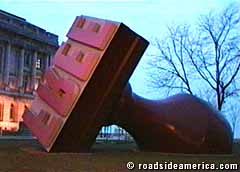
One of Cleveland's most infamous landmarks is the FREE stamp, a 28 foot tall, 48 foot long statue created by Claus Oldenburg & Coosje Van Bruggen. While currently located on East 9th and West Lakeside Avenue the original location was to be at the lobby of the SOHIO (now owned by BP) Building on public square. According to the artists the statement "FREE" was in reference to the ideals of independence and liberty however during construction of the sculpture British Petroleum (see also the gigantic Gulf Oil Spill currently occurring) purchased SOHIO (Cleveland's Standard Oil) and the new management did not like the idea of pop art at their front door. Some inference can be made that stamping the earth "FREE" was not in the corporate ideology of British Petroleum, a company that makes it fortune by selling minerals extracted from the earth to the earth's inhabitants. Regardless there was much brouhaha and the stamp was redesigned for its new location having been "flung" from it's place of origin.

I like the sculpture.

However, as the news bombards us with tales of the environmental and economic devastation occurring in the Gulf Coast due to a major disaster at an oil rig operated by British Petroleum I cannot help but stare at the FREE Stamp, laying on its side, discarded, and wondering that this long twisted path we are already so far down leads away from the freedom and liberty we profess to love. How fitting that once again Cleveland can so neatly fit into the national consciousness when it come to environmental warnings about our future.

image borrowed from roadsideamerica.com

Friday, May 14, 2010

Rejoice! Those horrible tomatoes of winter shall soon retreat from sight - Blue Pike Farm Open House 05.15

Blue Pike Farm Open House
May 15, 2010
10am - 2pm

It has been a long and cold winter. My biggest regret is the sever lack of tomatoes that had any flavor. I had become so spoiled on Carl Skalak's heirloom offerings and what little jewels I received in my local CSA that when I had to stoop to purchasing tomatoes from the grocery store, those sad little creatures picked before ready so as not to spoil in transit, the act of eating lost a little of its delight.

However hope springs eternal. The warming weather brings a glimpse of fresh veggie offerings so come and celebrate Blue Pike Farm's yearly rebirth with an Open House and see how a fantastic urban farm can not only transform a plot of forgotten land but also reconnect your senses back to the simple pleasure of enjoying good food.

Just a sampling of what you can enjoy:

John McCumber will be setting up his microscope display to see what kind of good critters are alive and swimming in the CPR and some locally grown vermicompost. Bring the kids for this fascinating biology lesson. He'll also be available to answer your questions about growing without petrochemical fertilizer, pesticides and herbicides.

The plant sale will have a wide selection of vegetables including, 2 varieties of asparagus, 5 varieties of seed potatoes, shallots, onions and more. Plus we have a special delivery of Envirosure Compost available in 40# bags with truck load pricing for open house visitors. You'll also be able to see how we are using it at BPF.

Joining us will be Lynn Thompson and her partner from Devils' Backbone and Educational Garden with a wide selection of heirloom vegetables and flowers. Here's her list:

Pingtung Long Eggplant (58 days) F-1 hybrid.
Diamond Eggplant (78 days) Open-pollinated.
Rosita Eggplant OG (84 days) Open-pollinated.
Black King Eggplant (79 days) F-1 hybrid.
Rosa Bianca Eggplant OG (88 days) Open-pollinated bicolor Italian heirloom.
Chocolate Sweet Pepper OG (80 days) Open-pollinated.
Bulgarian Carrot Chile Hot Pepper (68 days) Open-pollinated.
Early JalapeƱo Hot Pepper (75 days) Open-pollinated.
Long Red Narrow Cayenne Hot Pepper (75 days) Open-pollinated.
Anaheim Hot Pepper (78 days) Open-pollinated.
New Ace Sweet Pepper (60 days) F-1 hybrid.
Revolution Sweet Pepper (72 days) F-1 hybrid.
Flavorburst Sweet Pepper (75 days) F-1 hybrid.
Cosmonaut Volkov Tomato OG (65 days) Open-pollinated. Ind.
Pruden’s Purple Tomato OG (72 days) Open-pollinated. Ind.
Black Prince Tomato OG (75 days) Open-pollinated. Ind.
Green Zebra Tomato OG (77 days) Open-pollinated. Ind.
Cherokee Purple Tomato OG (77 days) Open-pollinated. Ind.
Paul Robeson Tomato OG (78 days) Open-pollinated. Ind.
Jubilee Tomato OG (80 days) Open-pollinated. Ind.
Rose de Berne Tomato OG (80 days) Open-pollinated. Ind.
Pink Brandywine Tomato OG (82 days) Open-pollinated. Ind. with potato-leaf foliage.
Aunt Ruby’s German Green Tomato OG (85 days) Open-pollinated. Ind. Goldie Tomato OG (90 days) Open-pollinated. Ind.
Black Cherry Tomato OG (75 days) Open-pollinated. Ind.
Fargo Yellow Pear Tomato OG (82 days) Open-pollinated.
Sun Gold Cherry Tomato (57 days) F-1 hybrid. Ind.
Sparky Mix French Dwarf Double Marigold
First Lady African MarigoldFO Fiesta Broccoli OG (86 days) F-1 hybrid.
Cassius Cauliflower OG (84 days) F-1 hybrid.
Sweet Basil OG (70 days)
Gigante d’Italia Parsley (70 days) Open-pollinated.
Imperial Star Globe Artichoke OG (120 days) Open-pollinated.

No need to RSVP. Just show up.

Monday, May 10, 2010

Can't See the City for the Trees - Urban Forest Mapping

Well, not really. The truth is that the idea of urban amenities is nice, however without any way to quantify "real" value there is difficulty in finding proper funding. Street trees for example add quite a bit to the urban environment from both a psychological and environmental perspective, however they are often treated as simple decorative additions to an already over burdened pedestrian pathway. This ends up with trees crammed into tight and unhealthy spots, burdening growth and doing nothing to add to the health or image of a street. A dead or dying tree on an urban thorough-way is a rather sad sight.

For the urban and planner nerds out there that love mapping, what if there was a way to map tree locations and quantify their value? Danger, leading question...

The Urban Forest Map creates an online presence where "tree people" and mappers can collect data about urban tree locations in and around San Francisco. When I entered Cleveland, Ohio the map basically told me to go to hell.

However, when it isn't acting like a prissy snaffergargle the Urban Forest Map (I like the logo too) shows the impact that the selected tress are having in terms of monetary evaluations of Greenhouse Gas, Water, Energy and Air Quality Benefits.

The mapping is collaborative and open to users and pretty darn nifty for those of us that have room in our hearts for trees, Google and mapping things. The intent of the site is to collect data for "urban foresters and city planners in better managing trees, allowing them to track and combat tree pests and diseases, and also plan future tree plantings. Additionally climatologists will be able to use the information to better understand the effects of urban forests on climates, and students and scientists can use the site to learn about the role of trees in the urban ecosystem.".

Funded by a "grant awarded by the the California Department of Forestry and Fire Protection (CalFire) funded by Proposition 84 they expanded the project and is now a collaboration of government, non-profits, businesses and individuals."

Pretty neato.

Friday, May 07, 2010

Kent State names a new dean (again, and also, FINALLY)

Kent State University has chosen a local architect to head its College of Architecture and Design.

Douglas Steidl will become the new dean of the college July 1. He replaces James Dalton, who will return to teaching at Kent State after two years as dean.

Mr. Steidl, who lives in Peninsula, has been a manager at Renard LLC, an investment, development and consulting firm in Peninsula, for the last three years. He previously founded Braun & Steidl Architects in Akron, which specializes in educational, religious, recreational and hospitality design projects.


After Fong's departure KSU CAED (how about that slew of acronyms?) has decided to slide away from a theoretical base (briefly offered by Fong) to continue the tradition of developing "professional and licensable architects" (quotes are author's own - consider them air quotes if you will). Whether "good" architects and designers will be produced will be the upcoming hurdle to overcome. I'm not saying that the exams aren't hard (I haven't even bothered to start my tests) just that by looking at the work produced by quite a few licensed architects it doesn't guarantee or qualify work produced as "good" or "interesting" or "worthwhile to experience" or even "good for the client" and not a "complete waste of money and materials".

For some insight into Mr. Steidl here is a reposting of some Q&A (copied here for when the link goes bad) from Vision 20/20. I'm not going to say I disagree with his comments, I just find it a little sad that the profession has to operate on the defense of quantifying its existing value instead of creating the demand for more and better design. However I do completely relish the thought that collaboration and facilitating collaboration among skilled professionals will replace the generalist approach to design (that I find all too often dilutes the final product into something with limited or no value). Who knows, the ability to specialize a college of architecture could strengthen the abilities of the students that are produced, and that wouldn't be a bad thing at all.

What will be the most significant challenge facing architecture and society in 2020? What is the relevance of architecture in this future?

The significant challenge facing the architecture profession in 2020 will be the architect’s capacity to resolving the complexity of demands applied from so many diverse directions on the creators of the built environment. These demands might be enumerated with some brief statements:

  • Codes and Standards will demand that building concepts are based on scientific determinants.
  • Builders will demand intimate delineation of construction procedures, and system interfaces.
  • Owners will demand a single source of responsibility for development, design, construction, finance and operations.
  • Governments will protect the environment demanding “zero carbon” designs and scientific analysis of the environmental impact of every structure.
  • Clients will demand more efficient buildings with greater distinction.
  • The public will demand more public input to design concepts for buildings, neighborhoods, and communities, focusing on quality of life issues.

Two phrases summarize the needs of the architect:
1. The ability to analyze and coordinate complexities through collaboration, and
2. The depth of empirical knowledge about all aspects of the development process from land acquisition through facility management.

The question of complexity, most likely will mean that today’s definition of “Architect”, is obsolete i.e. the designer is king. How much expertise can one individual incorporate into their understanding? Is it possible for a single practitioner to be real estate agent, super designer; environmental/sustainability expert; coordinator of design, construction, financing, operations and approval processes; materials guru; systems selector and integrator; facility manager and perform all these tasks within guaranteed time and budget dictates?

Even today, we do not operate independently. The idea that a Registration makes one competent to perform all the services included under our umbrella is ludicrous. Only through the collaboration of knowledge based expertise do we have the ability to undertake the complexities that face us as professionals.


How will a future “architect” think/operate in 2020, and what skills will be required?

Most Architects will perceive themselves as knowledge based specialists. In mid and large size offices in 2008, the division of tasks is divided among individuals with experiences and knowledge in specific areas. Programming with the client, schematic design, document production, specifications, sustainability issues, estimating, interiors, renderings, communications/coordination, and many other specific tasks are assigned to various team members. Generally, however, we still think of ourselves as all around architects, capable of performing any task assigned.

In 2020 the concept of generalist will be revised. Some architects may be coordinators of the design/construction process, leading an industry team which brings together specialists to jointly execute a project. Most architects however, will be those specialists, bringing a depth of knowledge that can only be termed task specific expertise, not generally achieved today by a majority of practitioners and definitely not taught by the majority of architectural education programs. We still value the “designer” moniker. In 2020 we will honor all task experts! The designer will be but one expert in the process and that individual had better utilize empirical knowledge to justify every decision about a design concept.

The word “my” will become a much stronger “our”. An architect’s identity will be equated with the team that completes a significant work enhancing communities, enrich the quality of life for citizens, and serving the public as well as the client. These facilities will use materials that are renewable, structures that are demountable, and produce zero-carbon. The team’s ego will be massaged, not by glossy pictures in peer magazines, but by recognition in public communiquĆ©s and respect from the average citizen.

Leadership will be the key to being in a position of decision making in the design/construction industry. Being the leader of the design team will not be enough to insure client trust. Only the few architects who invest themselves in finances, real estate, design knowledge, and have a depth of construction expertise will be in positions to interact with and influence the client.

The question is not how architects will think, but how the individual architect will think, and then how that architect will dedicate himself or herself to the tasks necessary to become a knowledgeable leader and collaborator.

Why are students uniquely positioned to address these issues?

The above is a new mindset. Instilled concepts are hard to change, and often, if revised, result in muddled thought patterns. Students start with a fresh perspective, they have the chance to see a more collaborative and factual world. Students have the opportunity to delve deeply in their greatest interest area, with years ahead of them in which to expand the depth of experiences that will give them the ability to communicate with unique tools while learning an expertise. And, they are in a community where they can interact with other disciplines and individuals from diverse cultures. This community will allow them to develop specialized expertise yet with a global comprehension. What an opportunity!


About Douglas Steidl, FAIA

A founding principal of Braun & Steidl (est. 1983), a general-practice architectural firm and recipient of AIA Ohio’s Gold Medal Firm Award, Doug Steidl directs the firm in its work providing architectural planning and interior design services for widely-recognized university, medical, religious and commercial projects. Presently, the staff of Braun & Steidl Architects consists of 41 professionals, including 13 registered architects. First elected to the AIA national Board of Directors for a 1998-2000 term, Steidl went on to serve the AIA as Vice President 2000-2001, Treasurer 2001-2003, and First VP 2003-2004. Steidl is also the 2008-2009 President of the National Architectural Accrediting Board.

Wednesday, May 05, 2010

The Future of the Malls: Public Forum - April 6th

Another Cleveland event that I wish I could go to but won't make. Instead I will be down at Kent State looking at student projects and attempting to give helpful advice without being a yelling jerk.

I won't hold missing this public forum against them. I will remember though, during the boring ones.

CUDC has the best blog posts.

Monday, May 03, 2010

Citizen Architect showing at CMA - May 5th

Citizen Architect

Citizen Architect: Samuel Mockbee and the Spirit of the Rural Studio
Wednesday, May 5, 7:00
Directed by Sam Wainwright Douglas, with Peter Eisenman, et al. This new documentary profiles late architect and educator Samuel Mockbee, whose groundbreaking Rural Studio at Auburn University created low-cost, innovative housing for the impoverished residents of Hale County, Alabama. Cleveland premiere.
USA, 2010, color, Beta SP, 57 min.


At some point the idea of architecture took on the burden of developing an idealistic fortitude wherein the welfare and benefit of mankind (or society) became an identifiable and paramount goal. The indemnification of aesthetic goals was more than merely conjoined with an over-reaching attitude to how the built environment can shape the wellbeing of its users. The idea of occupying space (and the emotional bindings created by this occupation) pushed buildings from being merely designed as representations of strength, wealth, power and religious fealty.

The proposition of shelter has always been a necessity coupled with such cloyingly sweet sentiments of "home is where the heart is" and "a man's home is his castle" whereas the burden of manageable shelter is shifted to the occupant. The idea of "making due" with the hand dealt freed designers from having to prepare responsible and fitting solutions. Soon the ideals of the built environment decided that design could help shape the social consciousness, lift the human spirit and attempt to react to needs of an ever shifting and changing family (and community) dynamic.

The argument that the grand social experiments of the 1950's (demonizing Bacon and Moses, perhaps properly) concentrated on large public works (demanding large amounts of capital) which tore apart the urban fabric to support the great sprawling suburbs while attempting to reshape "urban" life was a massive failure and resulting in stratification of economic class and the death of our great city's can be fought, the idea that the mechanization of human life on a grand scale does little to further instill a sense of our humanity. The grand projects (apartment blocks) destroyed the identity of our ethnic ghettos and displaced thousands of families who could not prosper without the support of their community (which was replaced with highways, interchanges and "proper" urban streets).

It was those that felt that the residential palette on an individual level, the small home, the tiny community centers and halls, could be made welcoming, well built and not interject an unwelcome or alien dialog to an already existent community that are currently making their mark on the world. They have decided that the small budget projects which require deliberate care and choice making in their crafting represent the most common of the human condition, those without the wherewithal to completely annihilate their history and start over from scratch. It is the current flock of design build studio's, Rural 804, Badanes Design/Build and University of Washington (Seattle) and perhaps the most touching and famous of them all, Samual Mockbee's Rural Studio of which the film Citizen Architect centers.

There is a place for the common sense of design and wonder we all seek and enjoy. The smooth contours of the iPhone, the felicitous curves of a 911 but there is room for wonder in design to be available to everyone, the hard part is finding the designers who are willing to sacrifice the time and ego to fulfill someone else's dream.

Thursday, April 22, 2010

PechaKucha Cleveland Vol. 7

PechaKucha night Cleveland - Vol. 7


April 23, 2010 8:20 pm – 10:20 pm

at Convivium 33 Gallery

FREE

1433 East 33rd Street, Cleveland, Ohio 44114

216-881-7828

http://www.josaphatartshall.com/


Welcome to Spring!!!!!!!!!!

On April 23rd, 2010, PechaKucha Night Cleveland will head to Convivium33 Gallery in Downtown Cleveland for the first warm weather PKN of the year!

Space will be tight so be sure to come early and enjoy a few beverages prior to being inspired, influenced, confused, provoked, and probably slightly intoxicated by the wonderfully variegated topic mix. A map of where Convivium is located as well as where you can park can be found here: http://www.flickr.com/photos/pkncleveland/4497515102/

Doors and bar open at 7:00pm. Be sure to keep an eye on the list of presenters as we may be adding one or two people up until the week of the 23rd!.

If you are interested in presenting at a future PechaKucha Night, have an idea for a venue, or have questions about PechaKucha Night, please contact us - we'd love to hear your ideas.

Be sure to bring a friend or two!

Cheers,
Mike Christoff & Raseem Parker
pkncleveland@gmail.com

Presenters

Lia Tomco

  • Austin Kotting
  • Steve Kordalski
  • Chris Maag
  • Heather Furman
  • Krista Van Wassen
  • Sukant Bhatnagar
  • Mike Mikula
  • Beth Buehner
  • Michael Christoff
  • Final Order Will Be Posted Day of Event!!!